
AMX annual reports are ballooning to 287 pages: compliance feels comfortable, readability gets left behind
The average AMX report now runs to 287 pages. No less than 80 per cent of mid-cap companies publish a report of more than 230 pages. Moreover, there are significant differences: Allfunds published the shortest report (154 pages), whilst Air France-KLM takes the crown with no fewer than 532 pages. The question is no longer whether organisations can produce reports. The question is whether anyone can still read them.
Annual reports have undergone a fundamental transformation in recent years. Whereas they used to be primarily a financial review, today they are a multi-layered strategic accountability document bringing together strategy, governance, sustainability, risks and financial performance. New regulations such as the CSRD have accelerated this development. For example, sustainability statements now account for an average of 25 per cent of the total content of AMX funds.
That is good news.
Greater transparency ultimately leads to better governance and better decision-making. But at the same time, a new problem is emerging.
Compliance wins. Communication loses.
Many organisations focus all their energy on complying with laws and regulations. And rightly so. But when a document runs to hundreds of pages, has dozens of authors and has to cater to an ever-increasing number of frameworks, the result is almost inevitably a report written primarily for auditors.
Not for investors. Not for staff. Not for customers. And ultimately, not for directors either. We see this reflected in many AMX annual reports. The technical quality and the ticking off of requirements are improving, but readability and communicative power often lag behind.
Why we developed the Annual Report Benchmark
At Mattmo, we have been helping organisations with corporate reporting since 1993. We kept seeing the same question come up: How good is our annual report, really, compared to other organisations?
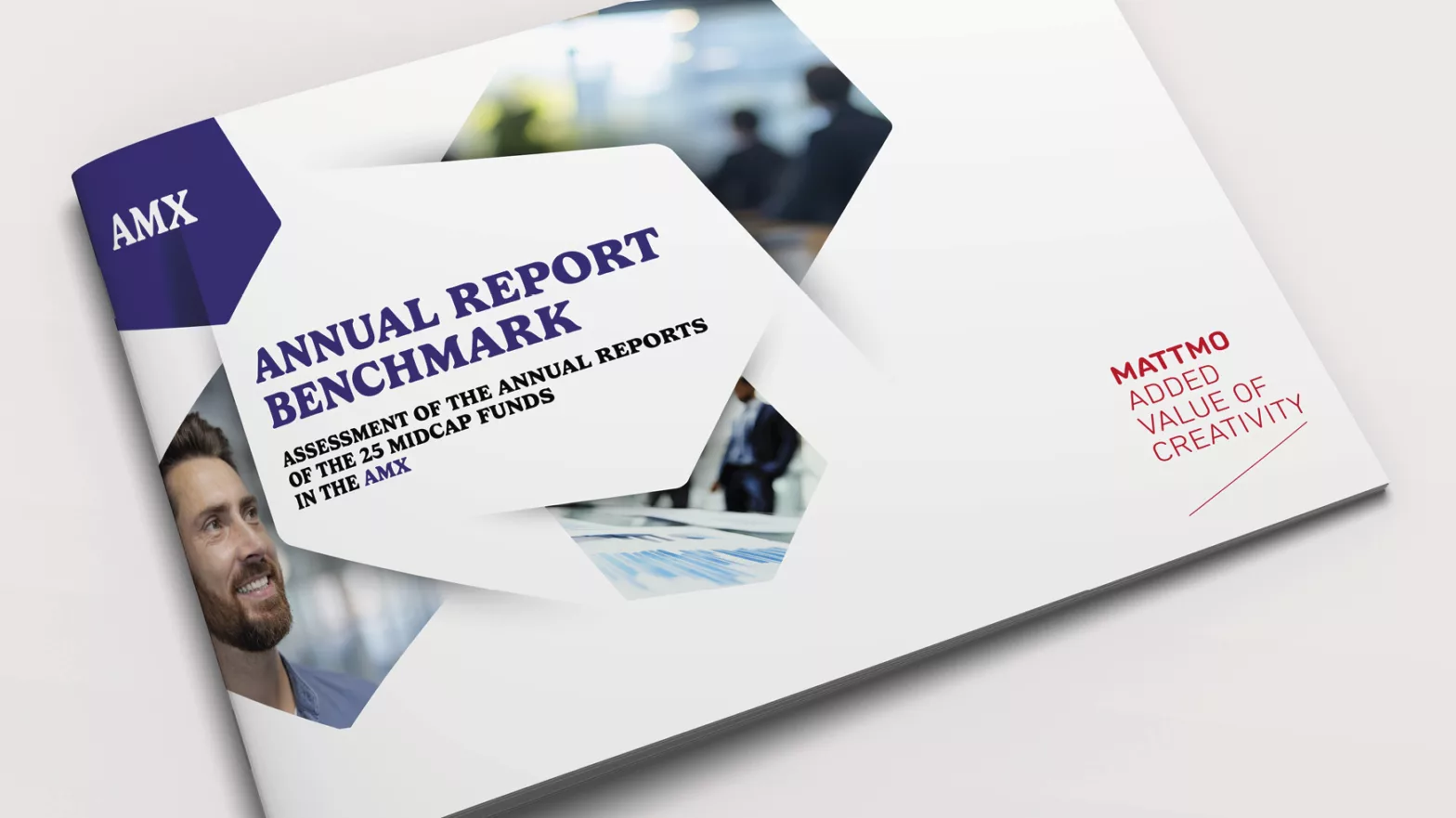
Strikingly, there was hardly any objective answer to this question. That is why we developed the AMX 2025 Annual Report Benchmark.
We analysed the annual reports of 25 AMX companies for the 2025 financial year and assessed them against four key criteria:
- Language & readability: Is the strategic message understandable to a broad audience?
- Digital accessibility (WCAG): Is the document digitally inclusive (including alt text and correct tagging)?
- Accountability & reporting frameworks: Does the report comply with frameworks such as CSRD/ESRS and does it provide the appropriate assurance?
- Machine-readability and digital navigation: Is the data structured efficiently and provided with logical navigation (such as PDF bookmarks)?
Not just from a regulatory perspective. But rather by asking: How user-friendly is this report actually?
What stood out to us?
The results show a clear pattern:
- Compliance is the absolute comfort zone
Virtually all mid-cap funds comply fully with reporting requirements and incorporate frameworks such as CSRD/ESRS. InPost stands out in this regard.
- Language and human touch lag behind
Many texts contain formal and dry jargon. Construction firms such as Heijmans and BAM do a good job of translating their complex strategies into understandable language, but organisations such as Van Lanschot, Vopak and Theon produce documents that are difficult to grasp.
- Significant differences in digital inclusivity
Digital accessibility for screen readers, for example, shows marked contrasts. Aalberts, Arcadis, Corbion and Vopak score very highly in this regard, in contrast to organisations such as Air France-KLM, Allfunds, Fugro and WDP.
- Landscape format is the norm, but navigation is often lacking
More than 75 per cent of companies now opt for a landscape format tailored to on-screen reading. However, in documents running to hundreds of pages, robust navigation is crucial. Aalberts and BAM guide both readers and algorithms flawlessly via PDF bookmarks and internal links, whilst other organisations create a digital maze.
Heijmans shows how it should be done
Our benchmark reveals that Heijmans’ annual report is the top-scoring one (closely followed by Signify and Aalberts).
Not because it is the thinnest report – at 329 pages, plus a 125-page sustainability statement, it is a substantial document. But Heijmans makes sharp editorial choices. It articulates a clear strategic positioning based on five pillars, provides concrete reporting on sustainability, and makes use of powerful bold statements and real-world case studies.
This demonstrates that quality lies not in fewer pages, but in better information architecture and a clear narrative.
The next step in corporate reporting
Annual reports are unlikely to become any shorter in the coming years. ESG, digital tagging, AI, XBRL and European regulations mean that the volume of information will only continue to grow.
This means that organisations can no longer simply ask themselves:
Are we complying with the rules?
But also: can our target audience still find, understand and trust the story?
In our view, that is precisely where the next step in corporate reporting lies. Not even more information, but better communication.
Download the AMX 2025 Annual Report Benchmark
Curious to find out how the 25 AMX companies score on readability, accessibility, machine-readability and reporting quality?
Download the Mattmo AMX 2025 Annual Report Benchmark or contact us for an objective review of your own annual report.